When AI Makes Coding Faster, and Debugging Harder
How AI accelerates development, complicates systems, and why confidence, not code, is the real bottleneck

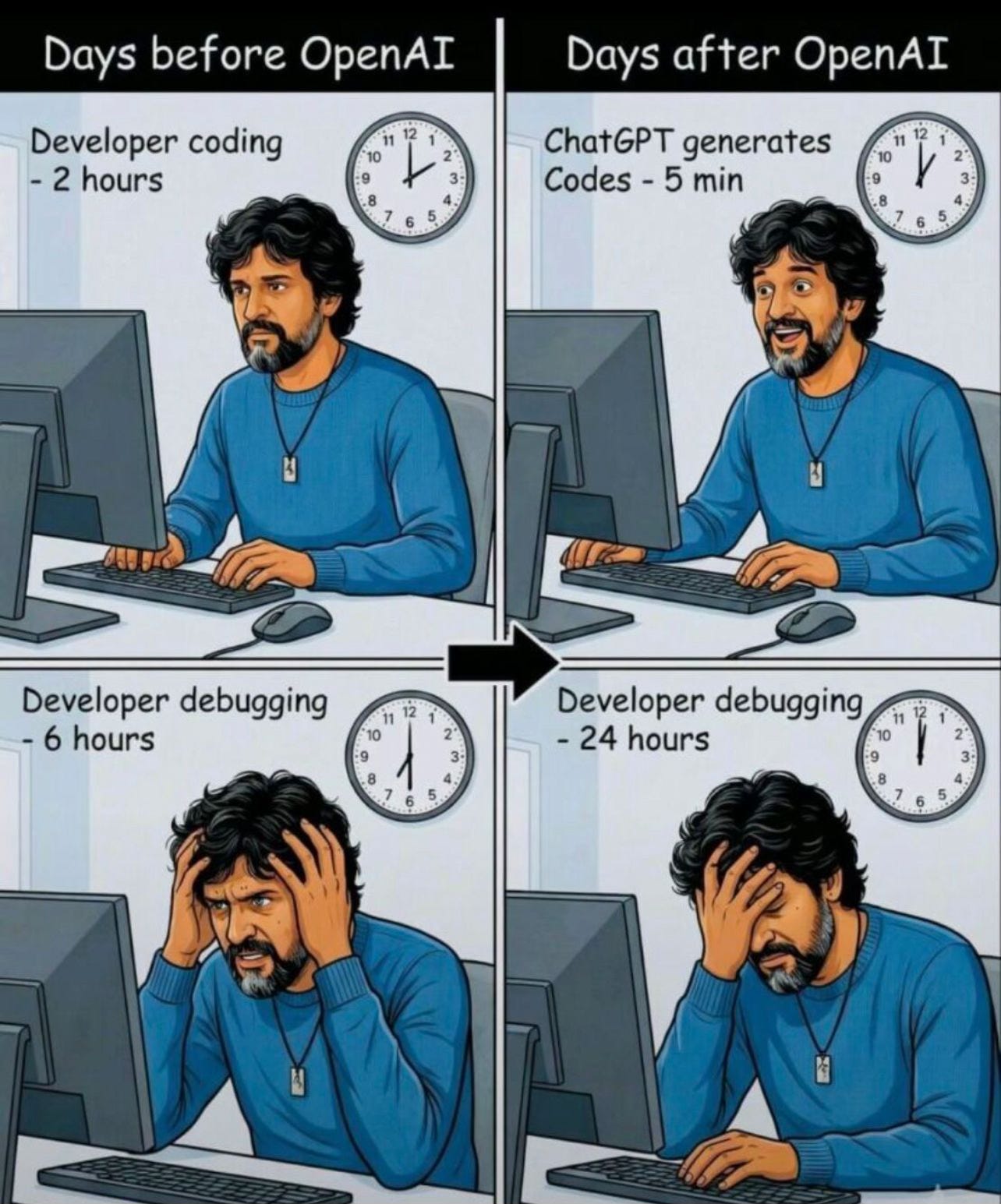
The Golden Age of Fast Development
A few years ago, shipping a new feature meant:
Reading requirements carefully
Designing APIs and data models
Writing code line by line
Manually testing multiple flows
Today?
Prompt → Code → Commit
With AI tools, developers can:
Generate APIs in minutes
Scaffold services instantly
Write complex logic without remembering syntax
Explore multiple approaches at lightning speed
Development has never been faster.
But there’s a catch.
Faster Code ≠ Safer Code
In real-world applications especially complex ones, features don’t live in isolation.
Every new feature interacts with:
Existing business rules
Data contracts
User workflows
Performance assumptions
Security constraints
The Hidden Risk
When you add or modify one feature, you might silently break three others.
This risk existed before AI, but AI amplifies it.
Why?
AI generates locally-correct code
Systems require globally-correct behavior
A Very Familiar Story
Let’s say you ask AI:
“Add a discount feature for premium users.”
AI delivers:
New DB fields ✅
Discount calculation logic ✅
API changes ✅
Looks perfect.
But later you discover:
❌ Existing invoices are miscalculated
❌ Refund flow is broken
❌ Reports don’t match totals
❌ Edge cases weren’t considered
Nothing crashed. Everything compiled.
But the system is now wrong.
A Real-World Example: Payments Feature Gone Wrong
Imagine a payments system in a production application.
Existing Flow (Working Fine)
User places an order
Payment is captured
Invoice is generated
Refunds and reports rely on the same data
Everything is stable.
New Feature Request
“Add partial payment support for enterprise users.”
You ask AI to implement it.
AI delivers:
New
payment_statusvalues ✅Updated payment calculation logic ✅
API changes for partial capture ✅
The feature works perfectly in isolation.
What Actually Breaks
A few days later, problems surface:
❌ Refunds return incorrect amounts
❌ Finance reports don’t match bank settlements
❌ Order status gets stuck in
PROCESSING❌ Edge cases fail during retries
No syntax errors. No crashes.
Just incorrect system behavior.
Why?
Because the AI optimized for the new feature, not for system-wide behavior.
Why Debugging Got Harder with AI
1. You Didn’t Write the Code
When AI writes code:
You didn’t think through every branch
You didn’t design every assumption
You didn’t anticipate every edge case
Debugging becomes archaeology instead of engineering.
2. Confidence Without Understanding
AI-generated code often:
Looks clean
Follows best practices
Uses correct patterns
This creates false confidence.
“It looks right, so it must be right.”
That’s dangerous.
3. Systems Are About Behavior, Not Code
AI is great at:
Functions
Classes
APIs
But weak at:
End-to-end flows
Business intent
Cross-feature impact
Your system breaks not because the code is bad, but because the behavior changed.
The Real Question Developers Must Ask
How do I know this AI-generated code is actually correct?
Not just:
Does it work?
Does it compile?
But:
Does it satisfy the feature fully?
Does it break existing flows?
Does it introduce hidden bugs?
Does it change system behavior?
This is where most teams struggle today.
What If We Had a Better Way?
Imagine a world where:
AI doesn’t just write code
AI understands system behavior
AI checks existing flows before changes
AI validates feature intent, not just syntax
Instead of asking:
“Write code for this feature”
We ask:
“Does this change break anything?”
That shift changes everything.
The Missing Layer: Confidence Engineering
What developers really need is not more code, but confidence.
Confidence that:
New features don’t break old ones
Modifications don’t alter intent
Edge cases are covered
Behavior remains consistent
This could come from:
Automated behavior validation
AI-assisted impact analysis
Flow-based testing instead of unit-only tests
Requirement-to-code traceability
Why Solving This Makes Developer Life Simple
If we solve this problem:
Development stays fast
Debugging becomes predictable
Refactoring becomes safe
Developers sleep better 😌
AI then becomes a true partner, not a risk amplifier.
Final Thought
AI didn’t make development harder.
It made our blind spots visible.
The next evolution isn’t faster code generation.
It’s knowing before production, what will break and why
Let’s Talk 👇
If you’re building real-world, complex systems with AI-generated code, this isn’t a future problem.
You’re probably feeling it already.
A feature that worked perfectly… until it hit production
AI-assisted change that broke an unrelated flow
A merge that looked safe but caused silent data issues
💬 I’d love to hear from you:
How do you deal with bugs introduced by AI-generated code?
What’s the hardest part for you when reviewing or merging AI-written features?
How do you gain confidence that nothing breaks?
Share your experiences or challenges in the comments 👇
Let’s learn from each other, and figure out how to make AI a true engineering partner, not just a fast code generator.
.