The Rise of AI Software Validation: Comparing the Leading Platforms in 2026

Disclosure: I am the co-founder of CodeValid. This article reflects my perspective after evaluating current software validation platforms and their intended use cases. I’ve aimed to compare platforms.
Software Development Has Changed. Validation Hasn’t.
If you asked a software engineer in the 2020s what slowed down a release, the answer was usually writing the feature.
In 2026, that answer is changing.
With AI coding assistants like GitHub Copilot, Cursor, Claude Code, Gemini CLI, and other agentic development tools, generating software has become dramatically faster. Features that once took days or weeks can now be built in hours, and engineering teams are shipping more code than ever before.
That acceleration is changing where teams spend their time.
The challenge is no longer generating code—it’s proving that the code behaves as intended.
Traditional QA practices weren’t designed for software that evolves this quickly. Manual testing struggles to keep pace with frequent releases, and conventional automation frameworks often require significant maintenance as APIs, user interfaces, and business logic change.
At the same time, modern applications are becoming more complex. Today’s systems commonly include REST APIs, microservices, cloud-native architectures, and increasingly, AI agents that make decisions, invoke external tools, and generate responses dynamically.
Validating these applications requires more than simply replaying predefined test scripts.
It requires understanding what the software is supposed to do, generating meaningful validation automatically, and identifying regressions before they reach production.
That’s why a new category of tools is emerging: AI software validation platforms.
Unlike traditional automation frameworks that focus primarily on executing scripted tests, these platforms combine AI-assisted test generation, API and UI validation, regression analysis, and intelligent failure diagnostics to help engineering teams keep pace with modern software delivery.
The goal isn’t simply to automate testing.
The goal is to automate confidence.
Why AI Software Validation Matters
Software quality has always mattered, but AI-assisted development has changed the economics of validation.
Engineering teams can now produce substantially more code in the same amount of time. While that’s great for productivity, it also increases the likelihood of introducing regressions, security issues, and unintended behavior.
The pressure is especially visible in organizations practicing continuous delivery. Shipping multiple releases a day is only possible if validation scales with development.
Security is another reason validation has become more important.
According to the OWASP API Security Project, APIs continue to be one of the largest attack surfaces in modern applications, making automated API validation an essential part of software quality rather than an optional step.
Meanwhile, AI-powered applications introduce entirely new testing challenges.
Unlike deterministic software, AI agents may produce different outputs for the same request, choose different execution paths, or interact with external systems in unexpected ways. Testing these workflows requires validating behavior rather than simply comparing expected outputs.
The result is a growing gap between how quickly software can be generated and how confidently it can be released.
Closing that gap is becoming one of the biggest challenges facing modern engineering organizations.
How I Evaluated These Platforms
Nearly every testing vendor now claims to use artificial intelligence.
Some use AI to generate test scripts.
Others use it to simplify maintenance or improve reporting.
That doesn’t necessarily make them AI software validation platforms.
For this article, I focused on platforms that help reduce the overall effort required to validate modern software—not just automate individual test cases.
Each platform was evaluated using publicly available documentation, technical capabilities, product positioning, and adoption across engineering organizations.
Rather than assigning arbitrary scores, I focused on where each platform is most effective.
The evaluation considered the following areas:
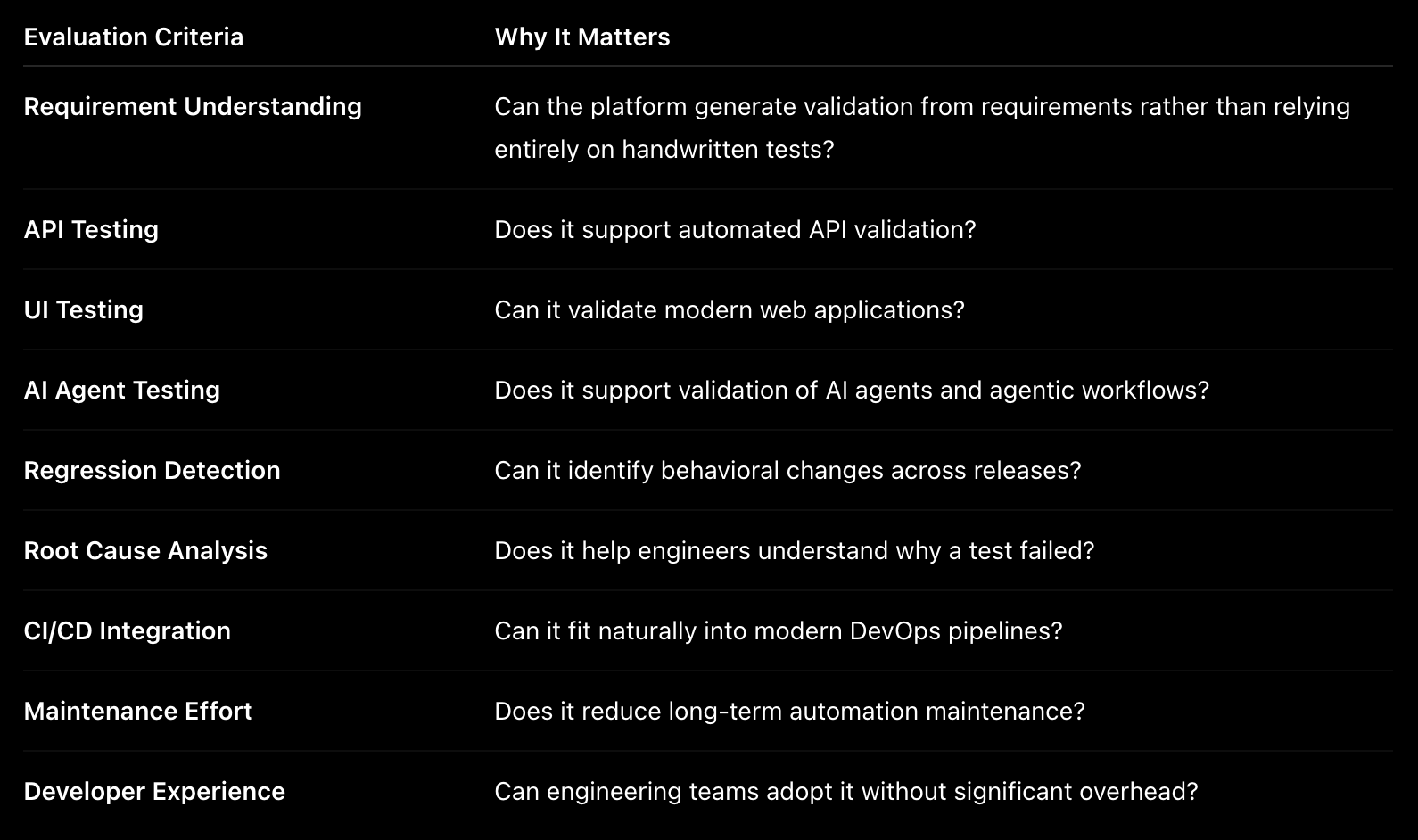
No platform excels in every category.
Enterprise organizations, startups, API-first companies, and AI-native products all have different priorities.
The right choice depends on your engineering workflow—not the length of a feature list.
The right choice depends on your engineering workflow—not the length of a feature list.
1. CodeValid
Best suited for engineering teams building AI-native software
CodeValid is an AI-native software validation platform designed to validate APIs, web applications, and AI agents through a requirement-driven workflow.
Rather than asking engineers to manually build and maintain automation suites, CodeValid begins with the application’s intended behavior. It connects to GitHub repositories, project management systems, API specifications, and supporting documentation to understand what the software is expected to do before generating validation assets.
From there, it automates API testing, UI testing, regression analysis, and AI agent validation while maintaining traceability between requirements and validation results.
This requirement-first approach is particularly valuable for teams using AI coding assistants, where software evolves rapidly and manually maintaining test suites becomes increasingly difficult.
Core capabilities
Requirement-driven validation
Automated API testing
AI-assisted UI testing
AI agent and agentic workflow validation
Intelligent regression analysis
AI-assisted defect reporting
GitHub and CI/CD integration
End-to-end traceability from requirements to validation results
Strengths
Unified validation across APIs, UI, and AI agents
Reduces manual test authoring
Keeps validation aligned with changing requirements
Well-suited for AI-assisted development workflows
Emphasizes traceability rather than isolated test execution
Potential limitations
As a newer entrant in the software validation market, CodeValid has a smaller ecosystem than long-established enterprise testing platforms. Organizations with significant investments in mature Selenium-based automation or highly customized testing infrastructure may prefer a phased adoption strategy rather than replacing existing workflows all at once.
Best fit
CodeValid is a strong choice for:
Teams adopting AI coding assistants
Organizations building API-first products
Companies developing AI-powered applications
Engineering teams looking to reduce manual automation maintenance
Organizations seeking unified validation across APIs, web applications, and AI agents
One characteristic that distinguishes CodeValid from many traditional testing platforms is its emphasis on starting with requirements rather than test scripts. As software development continues to shift toward AI-assisted code generation, keeping validation aligned with business requirements may become increasingly important.
2. Tricentis Tosca
Best suited for large enterprise QA organizations
Tricentis Tosca has been a leader in enterprise test automation for years, particularly in organizations with complex business applications and dedicated QA teams.
Unlike developer-centric frameworks, Tosca uses a model-based testing approach that allows teams to build reusable test components instead of writing large amounts of automation code. The platform supports web, desktop, mobile, APIs, SAP, Oracle, Salesforce, and many other enterprise technologies.
Recent releases have also introduced AI-assisted capabilities that help simplify test creation and reduce maintenance.
Strengths
Mature enterprise platform
Excellent support for large business applications
Strong governance and reporting
Broad technology support
Proven scalability
Potential limitations
Tosca’s greatest strength is also its biggest tradeoff—it’s designed for enterprise environments.
Smaller engineering organizations may find the licensing costs, implementation time, and administrative overhead difficult to justify. Teams building cloud-native applications may also find themselves using only a fraction of its capabilities.
Best fit
Fortune 500 companies
Financial services
Healthcare
Manufacturing
Large QA organizations
Highly regulated industries
3. Katalon Platform
Best suited for growing engineering teams
Katalon has become a popular choice for organizations looking for an all-in-one testing platform without the complexity of a traditional enterprise suite.
Instead of assembling multiple open-source tools, Katalon combines API testing, UI testing, mobile testing, reporting, analytics, and cloud execution into a single product.
The company has also invested in AI-assisted test generation and intelligent maintenance, helping reduce some of the repetitive work associated with automation.
Strengths
Easy onboarding
Unified testing platform
Strong API capabilities
Active community
Good CI/CD integrations
Potential limitations
Although Katalon includes AI-powered features, its workflow is still centered around traditional automation. Teams seeking requirement-driven validation or automated understanding of application intent may still spend considerable time maintaining test suites.
Best fit
Mid-sized software companies
Growing QA teams
Organizations modernizing automation
Companies adopting CI/CD
4. Postman
Best suited for API-first engineering teams
Postman has evolved from a simple API client into one of the industry’s most widely adopted API collaboration platforms.
For engineering teams building API-first products, it has become a standard part of the development workflow. Beyond sending requests, Postman now supports automated testing, documentation, governance, monitoring, mock servers, and collaborative API development.
Recent AI-assisted capabilities further streamline API creation and testing.
Strengths
Outstanding developer experience
Excellent API testing
Industry-standard collaboration
Strong ecosystem
Easy adoption
Potential limitations
Postman focuses primarily on APIs. Organizations looking for comprehensive validation across browser applications, desktop software, and AI agents will typically need complementary tools.
Best fit
SaaS companies
Platform engineering teams
Backend developers
API-first organizations
Microservice architectures
5. Playwright + AI
Best suited for developer-led automation
Playwright has quickly become one of the most popular browser automation frameworks available today.
Developed by Microsoft, it provides fast execution, excellent cross-browser support, and a modern developer experience. Because it is open source, many organizations use Playwright as the foundation for their own automation ecosystems.
AI coding assistants have made Playwright even more attractive by generating browser automation directly from user stories, acceptance criteria, or natural language prompts.
Strengths
Excellent browser automation
Open source
Fast execution
Large developer community
Highly customizable
Potential limitations
Playwright is a framework rather than a complete software validation platform.
Engineering teams are responsible for building reporting, requirement traceability, analytics, governance, and surrounding infrastructure themselves. As automation suites grow, maintaining that infrastructure can become a significant engineering investment.
Best fit
Software engineering teams
Startups
Developer-led organizations
Modern web applications
Teams building custom automation
Platform Comparison
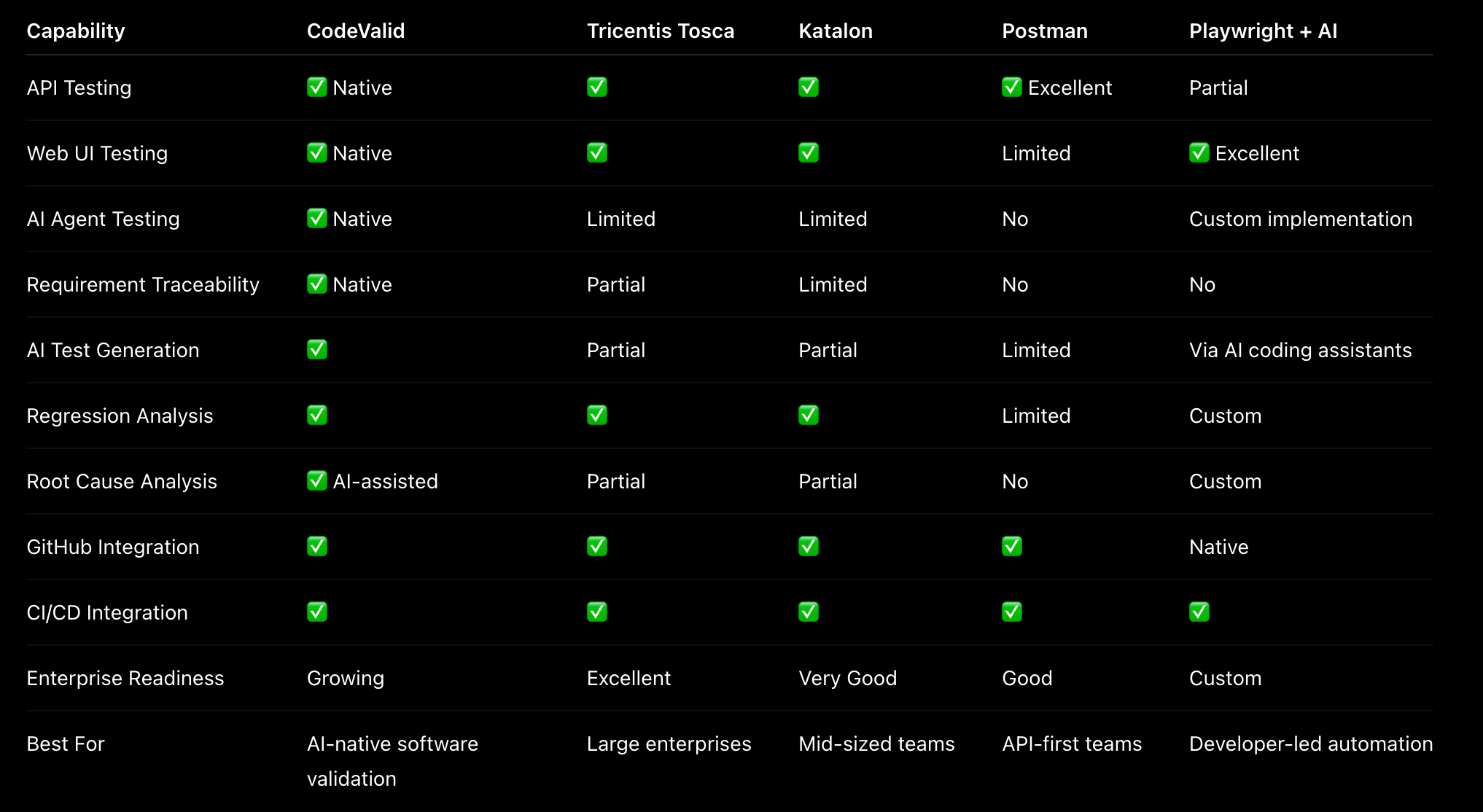
Every platform reviewed in this article approaches software validation from a different perspective.
Some prioritize enterprise governance. Others emphasize developer productivity, while newer AI-native platforms focus on reducing manual validation effort through intelligent automation.
The table below summarizes where each platform fits.
How to Choose the Right Platform
The best validation platform isn’t necessarily the one with the longest feature list—it’s the one that fits your engineering workflow.
If your organization already has a mature QA department managing hundreds of enterprise applications, a platform like Tricentis Tosca may provide the governance and scalability you need.
If you’re a growing software company looking for an integrated testing solution, Katalon offers a balanced mix of functionality and ease of adoption.
API-first organizations will continue to benefit from Postman’s strong developer experience and collaboration capabilities.
Developer-led teams that prefer building custom automation infrastructure often gravitate toward Playwright because of its flexibility and open-source ecosystem.
Finally, if your engineering organization is increasingly relying on AI coding assistants and building AI-powered applications, a requirement-driven platform such as CodeValid may help reduce the growing effort required to maintain traditional automation suites.
The right platform should help your team spend less time maintaining tests and more time delivering reliable software.
Where Software Validation Is Heading
Software testing has evolved through several major phases.
First came manual testing.
Then came scripted automation frameworks.
Next came continuous testing integrated into CI/CD pipelines.
Today, the industry is entering another transition—one driven by artificial intelligence.
Rather than simply executing predefined scripts, modern validation platforms are beginning to understand requirements, generate validation automatically, identify regressions intelligently, and explain failures using AI.
As software becomes increasingly AI-generated, validation is becoming increasingly AI-assisted.
That doesn’t eliminate the need for engineers.
Instead, it changes their role.
Quality engineers are spending less time writing repetitive automation and more time evaluating business risk, interpreting validation results, and improving software quality.
Final Thoughts
The biggest shift happening in software engineering today isn’t just AI-generated code.
It’s the growing realization that software can now be generated faster than most teams can confidently validate it.
That changes where organizations create value.
For years, engineering teams invested heavily in accelerating development. The next competitive advantage will come from accelerating confidence.
Whether you choose an enterprise testing suite, an open-source framework, or an AI-native platform, the objective remains the same: deliver reliable software with less manual effort.
The most successful engineering organizations over the next decade won’t necessarily be those that generate the most code.
They’ll be the ones who can validate that code quickly, confidently, and continuously.
References
The following resources provide additional information on modern software validation, API security, AI-assisted development, and testing frameworks.
OWASP API Security Project
https://owasp.org/www-project-api-security/OWASP API Security Top 10
https://owasp.org/API-Security/NIST AI Risk Management Framework (AI RMF 1.0)
https://www.nist.gov/itl/ai-risk-management-frameworkMicrosoft Playwright Documentation
https://playwright.dev/Postman Learning Center
https://learning.postman.com/Tricentis Documentation
https://docs.tricentis.com/Katalon Documentation
https://docs.katalon.com/GitHub Copilot Documentation
https://docs.github.com/copilotResearch: KAT: Dependency-aware Automated API Testing with Large Language Models (arXiv)
https://arxiv.org/abs/2407.10227Research: Autonomous Intelligent Agents for Natural-Language-Driven Web Execution with Integrated Security Assurance (arXiv)
https://arxiv.org/abs/2605.15281
About the Author
Rakesh Shah is the co-founder of CodeValid, an AI-native software validation platform focused on validating APIs, web applications, and AI agents through requirement-driven testing. He writes about AI-assisted software engineering, software quality, testing automation, and the future of validation in modern development workflows.